


I remember the moment clearly.
We were in a war room with one of our largest enterprise customers. They were in the middle of a major transformation — a complex landscape of core systems, integrations, and business-critical processes.
From the outside, everything looked modern. The integration platform was in place. The interfaces were running. The project appeared technically sound.
Then a major production outage hit.
At first, everyone assumed it was a technical problem. Something must have broken. But as the discussion unfolded, someone asked a very simple question:
“Do we actually know what our system can handle right now?”
The room went quiet.
Nobody could answer. Not because the people were not capable. Not because the technology was inadequate. The problem was that there was no end-to-end visibility, no real capacity planning, no clear ownership across teams, and no shared understanding of how changes in one part of the landscape affected another.
That was the moment it became very clear to me that the real problem was not integration.
It was governance.
The systems were connected. But there was no architectural layer providing the control, observability, and accountability needed to operate with confidence at scale.
I have seen versions of that same situation many times since — across different companies, industries, and technology stacks. The pattern is always the same: when governance is treated as something to add later, organisations only discover what they do not control after something goes wrong.
That insight is one of the reasons we built Maicell around Governed Intelligence as the operating principle — not as a feature, but as the architectural foundation. And it is one the boardroom conversation in Europe has not caught up with yet.
What the governance gap actually is
There is a conversation happening in boardrooms across Europe right now.
The board wants AI. The CTO knows something the board does not.
Not that AI is too complex. Not that the technology is not ready. The technology is ready. The models work. The APIs are available. The data pipelines can be built.
What the CTO knows is something harder to explain in a board meeting.
The infrastructure for governing AI — observing it, constraining it, auditing it, overriding it — does not exist yet in most enterprise environments. And almost nobody is talking about it.
That is the governance gap.
Let me be precise about what I mean, because it is easy to confuse this with adjacent problems.
The governance gap is not a security problem — though it creates security risks.
It is not a data privacy problem— though it creates data privacy exposure.
It is not a compliance problem — though it will become one.
The governance gap is the absence of a layer between what AI is capable of doing and what an enterprise has decided it is allowed to do.
When an AI model makes a decision — routing an order, flagging a customer, triggering a downstream process, acting on data from your ERP — who decided the boundaries of that decision in advance? What policy governed it? What audit trail recorded it? What mechanism exists to override it if it is wrong?
In most enterprise AI deployments today, the honest answer is: none of the above.
Not because the teams are careless. Because the architectural layer that enables governance was not part of the original design. It was assumed. Or deferred. Or treated as a compliance requirement for a later sprint.
That deferred decision is now the most expensive one in enterprise AI.
Why the market is not naming this
Vendors have a structural incentive not to name the governance gap.
If you are selling AI capability, you want the conversation to be about what AI can do — speed, accuracy, automation, scale. The governance question slows the sale. It introduces complexity. It asks the buyer to think about accountability structures they have not built yet.
Buyers, for their part, are often not asking the governance questions because the failure mode is invisible until it is not.
An AI model that makes 10,000 decisions a day without governance does not look broken from the outside. It looks fast. It looks efficient. The errors are distributed across thousands of micro-decisions that individually seem small.
Until the regulator asks for an audit trail that does not exist.
Until a customer decision is traced back to a model that had been drifting for three weeks.
Until a downstream process that AI triggered cannot be rolled back because nobody built that capability.
At that point, the governance gap is no longer invisible. It is a crisis.
What governance actually requires
Governance in enterprise AI is not a dashboard.
I want to be direct about this because the market is filling with tools that show you what your AI did — observability platforms, monitoring dashboards, audit logs. These are necessary. They are not governance.
AI observability tells you what your AI did. Governed Intelligence prevents it from doing what policy forbids.
Observability is knowing what your AI did.
Governance is deciding what your AI is allowed to do — before it does it.
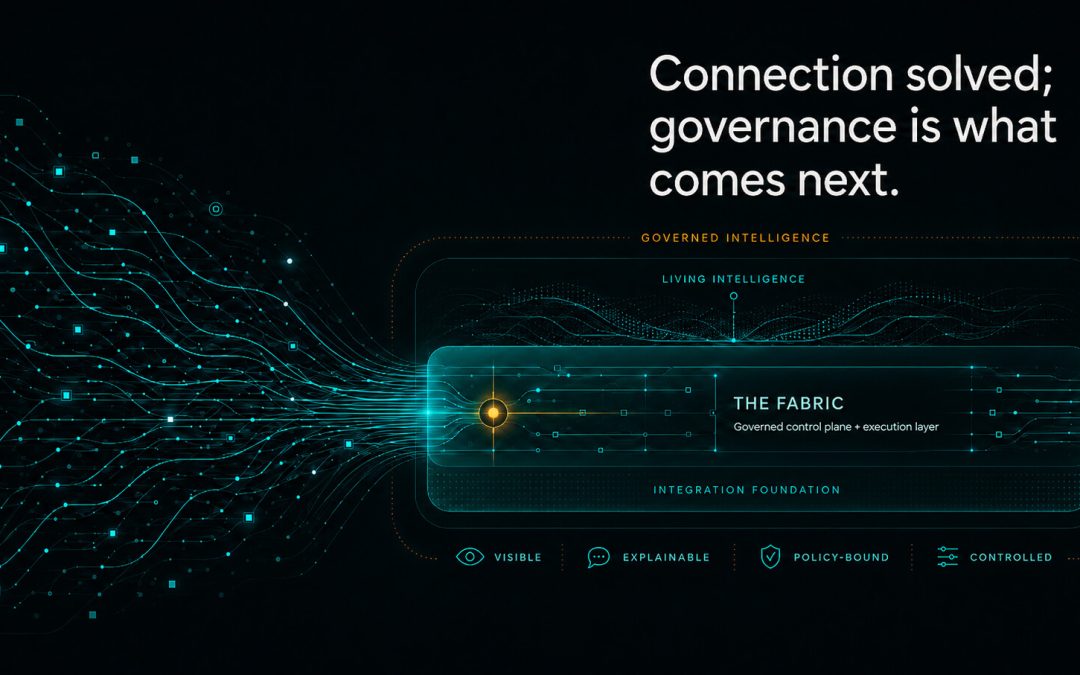
Real governance is an architectural decision. It means building four things:
1. Visible.
The reasoning can be reconstructed in business language.
2. Explainable.
Every decision, every data source consulted, every downstream action triggered — logged in a structured form that a human can read and a regulator can audit.
3. Policy-bound.
Actions are checked against enterprise rules before they become operational outcomes.
4. Controlled.
Exceptions can be blocked, routed, escalated, or corrected with the audit trail intact.
A system that lacks any one of these four properties is not governed. It is monitored. That is a different thing.
This is what we call Governed Intelligence. Not AI with a compliance layer bolted on afterward. Intelligence that is designed from the start to operate within boundaries set by the enterprise that runs it.
The EU AI Act changes the stakes
The EU AI Act is moving AI governance from policy discussion into operational reality. The exact timelines vary by system type and obligation, but the direction is clear: organisations will need to demonstrate visibility, explainability, human oversight, and auditability around AI-driven decisions.
None of that can be solved with documentation alone. It requires governance to exist inside the operating architecture, where decisions are made, executed, recorded, and controlled.
Why governance enables speed, not just safety
There is a common assumption I want to challenge directly.
The assumption is that governance slows AI down. That adding oversight, policy enforcement, and audit capability creates friction that reduces the business value of AI.
The opposite is true.
The governance layer is what makes it safe to give AI more autonomy. It is the infrastructure that earns organisational trust. Without it, every expansion of AI’s role in enterprise operations is a political negotiation — legal wants sign-off, compliance wants documentation, operations is nervous. The expansion stalls.
With the governance layer in place, expansion is systematic. You expand what AI is allowed to do by changing policy — not by rebuilding architecture. You earn trust incrementally. You move faster.
Governance is not the brake on enterprise AI. It is the accelerator.
The question every CTO should be asking
If you are deploying AI in your enterprise environment right now, here is the question worth asking:
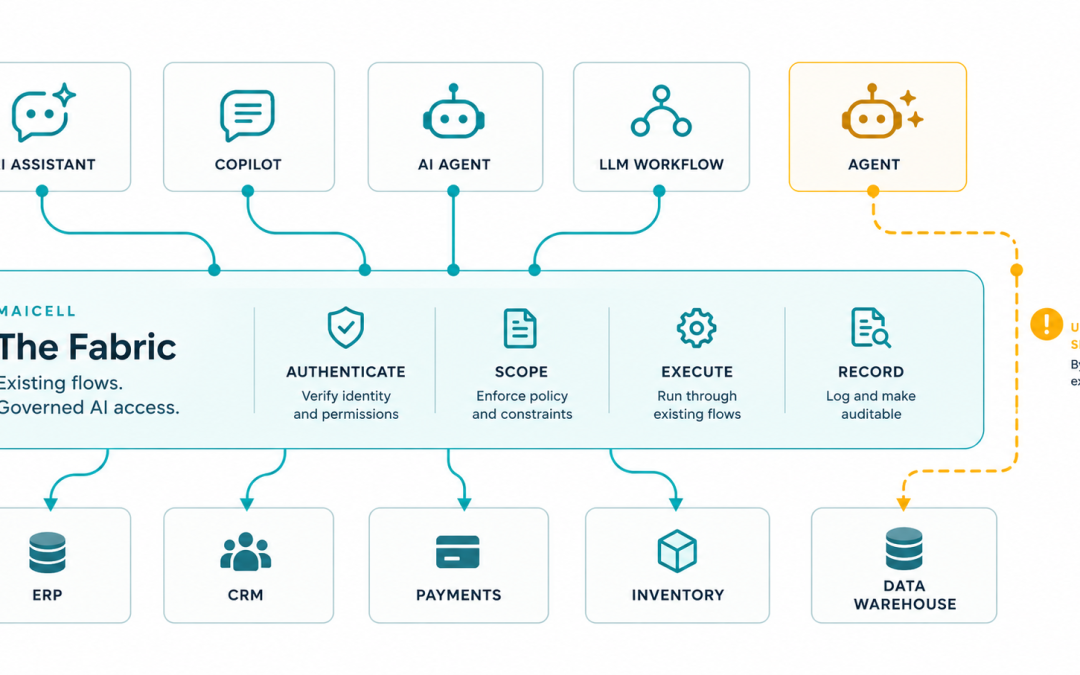
Do we have a Governed Intelligence layer; a governed control plane? Not a dashboard. Not a compliance document. A governed control plane — the architectural layer where AI policy is defined, enforced, audited, and overridden.
If the answer is no, you have the governance gap. Most enterprises do.
The good news is that closing it is an architectural decision, not a technology problem. The models are not the issue. The integration pipelines are not the issue. The governed layer between them and your enterprise systems — that is where the work is.
At Maicell, that layer is called The Fabric. The governed control plane for enterprise AI — observable, policy-aligned, and controllable by design. Not a compliance add-on. The foundation.
But regardless of how you build it, the first step is naming the gap clearly.
The governance gap is real. It is widespread. And it is worth talking about before the first incident makes the conversation unavoidable.



0 Comments