

EU AI ACT COMPLIANCE
2 August 2026
AI that cannot be governed cannot be defended
The EU AI Act makes governance a condition of operating AI in the enterprise. The Act requires governance at the execution layer. Maicell® builds it there.
What the Act requires
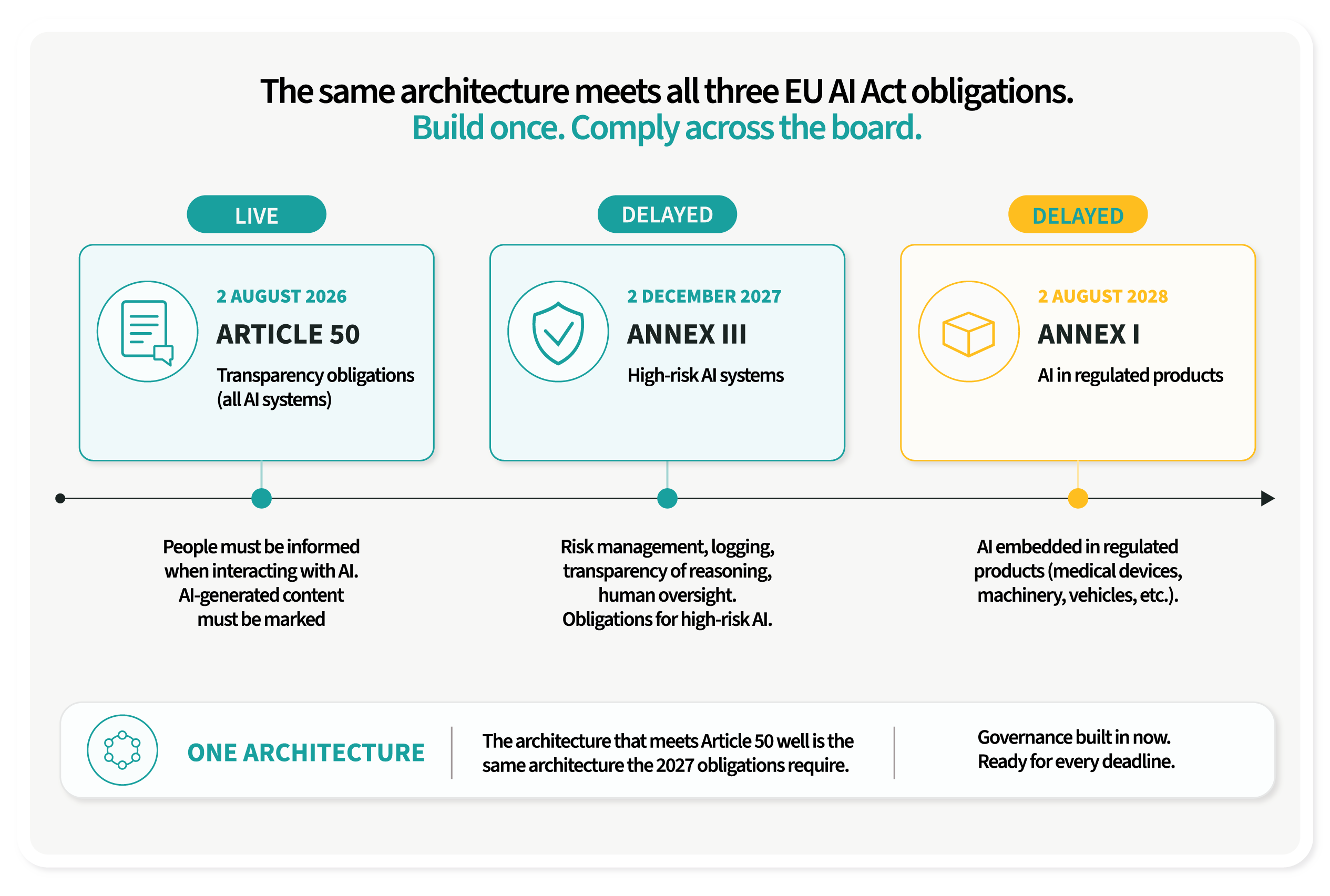
Three deadlines.
One architecture.
The EU AI Act applies in stages. Understanding which obligations land when is the first step to preparing for them. From 2 August 2026, Article 50 transparency obligations come into force. Any enterprise that runs AI that interacts with people or generates content must disclose that AI is in use and mark AI-generated material. These obligations apply broadly, not only to systems classified as high-risk.
These deadlines call for the same underlying architecture. Visibility, explainability, policy enforcement, and human oversight are not separable obligations bolted on at different times. They are properties a system either has by design or has to be rebuilt to acquire. The enterprises that build them for August are the ones ready for December 2027 without a second rebuild.
Governed Intelligence is the framework Maicell has built for this.
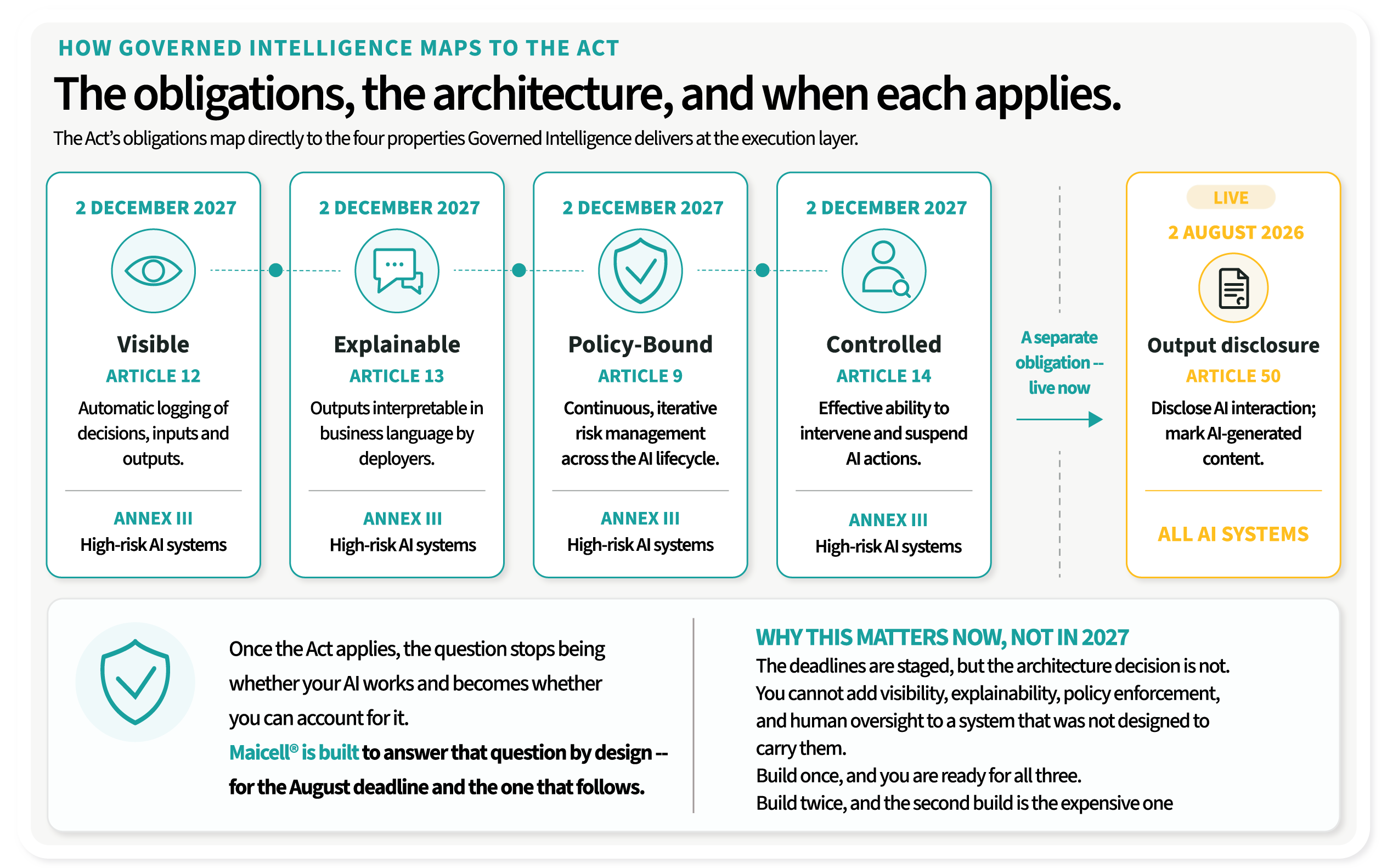
HOW GOVERNED INTELLIGENCE MAPS TO THE ACT
The obligations, the architecture, and when each applies.
The four properties of Governed Intelligence answer the high-risk obligations under Annex III, deferred by the Digital Omnibus to 2 December 2027. AI embedded in regulated products under Annex I follows from 2 August 2028. Article 50 output disclosure is a separate obligation, already live from 2 August 2026, and applies to all AI — not only high-risk systems.
Once the Act applies, the question stops being whether your AI works and becomes whether you can account for it. Maicell is built to answer that question by design — for the August deadline and the one that follows.
Why this matters now, not in 2027: The deadlines are staged, but the architecture decision is not. You cannot add visibility, explainability, policy enforcement, and human oversight to a system that was not designed to carry them, any more than you can add foundations to a building after it is occupied.
Article 50 brings the first obligations forward to August 2026. Build once, and you are ready for all three. Build twice, and the second build is the expensive one.
why it must be built in
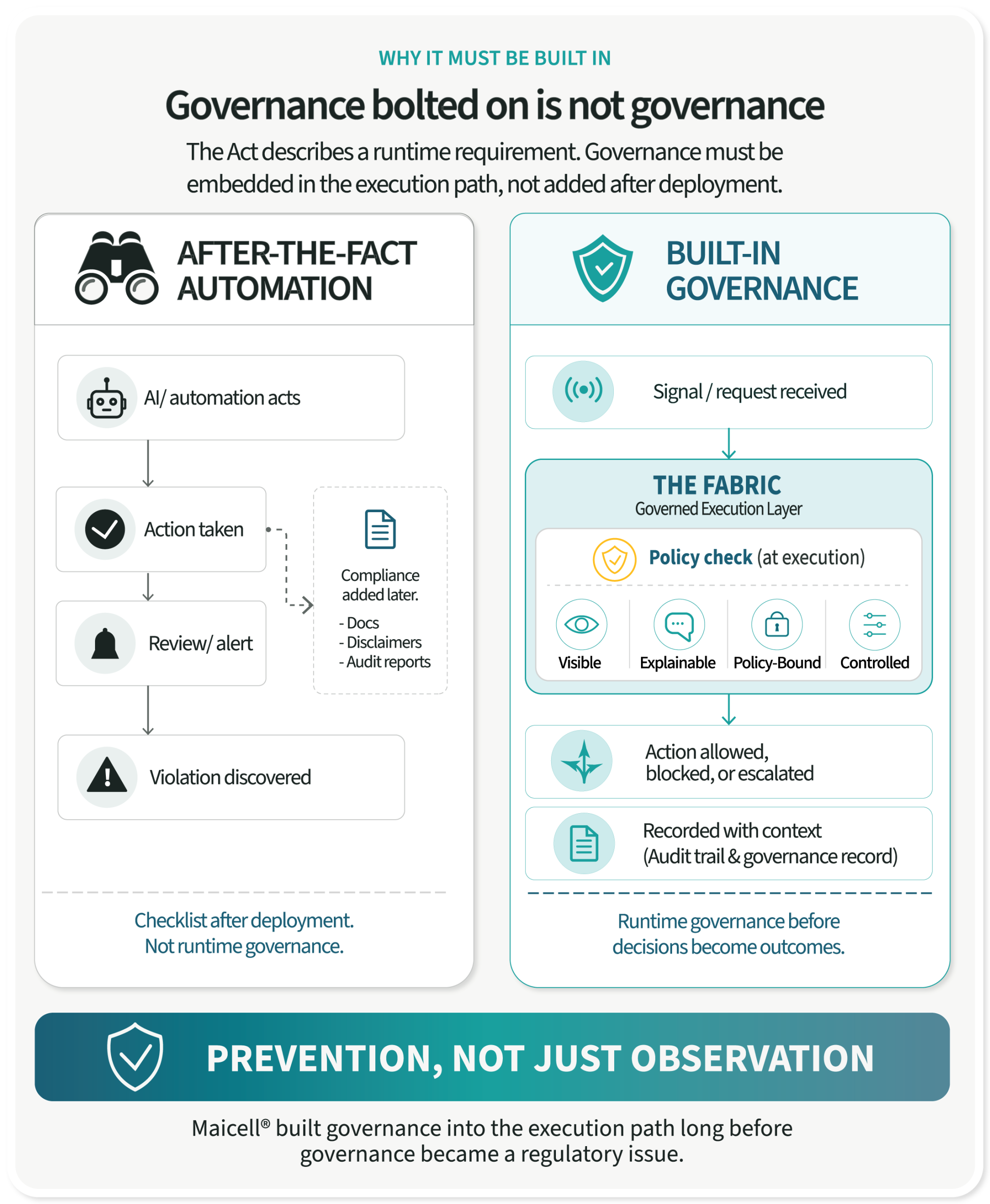
Governance bolted on is not governance
Most enterprises will attempt to comply with the EU AI Act by adding documentation, disclaimers, and audit reports after deployment. That approach satisfies a checklist. It does not satisfy the Act.
Article 9 requires risk management as a continuous, iterative process throughout the AI system lifecycle. A quarterly review will not produce this. Article 12 requires automatic logging at the moment of execution. Retrospective records reconstructed for regulators will not produce this either.
The compliance architecture the Act describes is a runtime requirement. The Fabric embeds it in the execution path, before decisions become outcomes and before logs need to be reconstructed.
regulated verticals
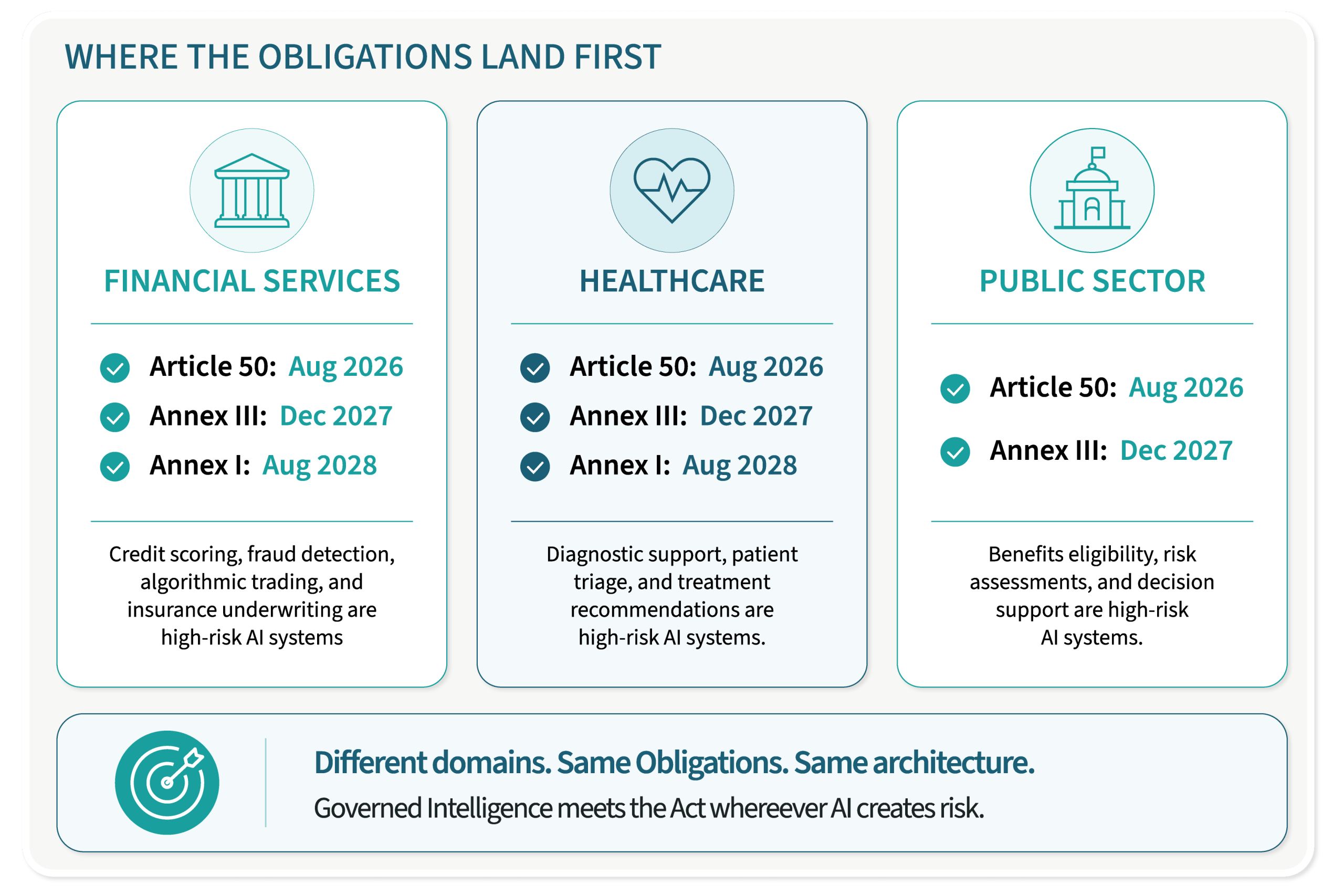
Where the obligation lands first
The Act’s obligations fall differently across sectors. The three below face the clearest near-term exposure.

Financial services
AI in customer communications faces Article 50 transparency obligations from August 2026. AI in credit decisions and fraud detection is likely to fall under Annex III high-risk classification, with obligations from December 2027.
DORA and the EU AI Act intersect here: the same systems that need operational resilience need governance auditability. The period to December 2027 is preparation time, not waiting time, because the architecture cannot be retrofitted at the deadline.

Healthcare
Patient-facing AI faces obligations across more than one timeline. Communication and triage tools that interact with patients may carry Article 50 transparency obligations from August 2026.
AI classified as high-risk under Annex III faces obligations from December 2027. AI embedded in regulated medical devices under Annex I faces obligations from August 2028. Which timeline applies depends on the specific system and its classification.

Public sector
Citizen-facing AI services carry Article 50 transparency obligations from August 2026.
Many public-sector AI uses — including those touching access to services and benefits — are likely to fall under Annex III high-risk classification with obligations from December 2027. Public sector procurement in regulated EU markets is already asking for evidence of governance infrastructure rather than plans for it.
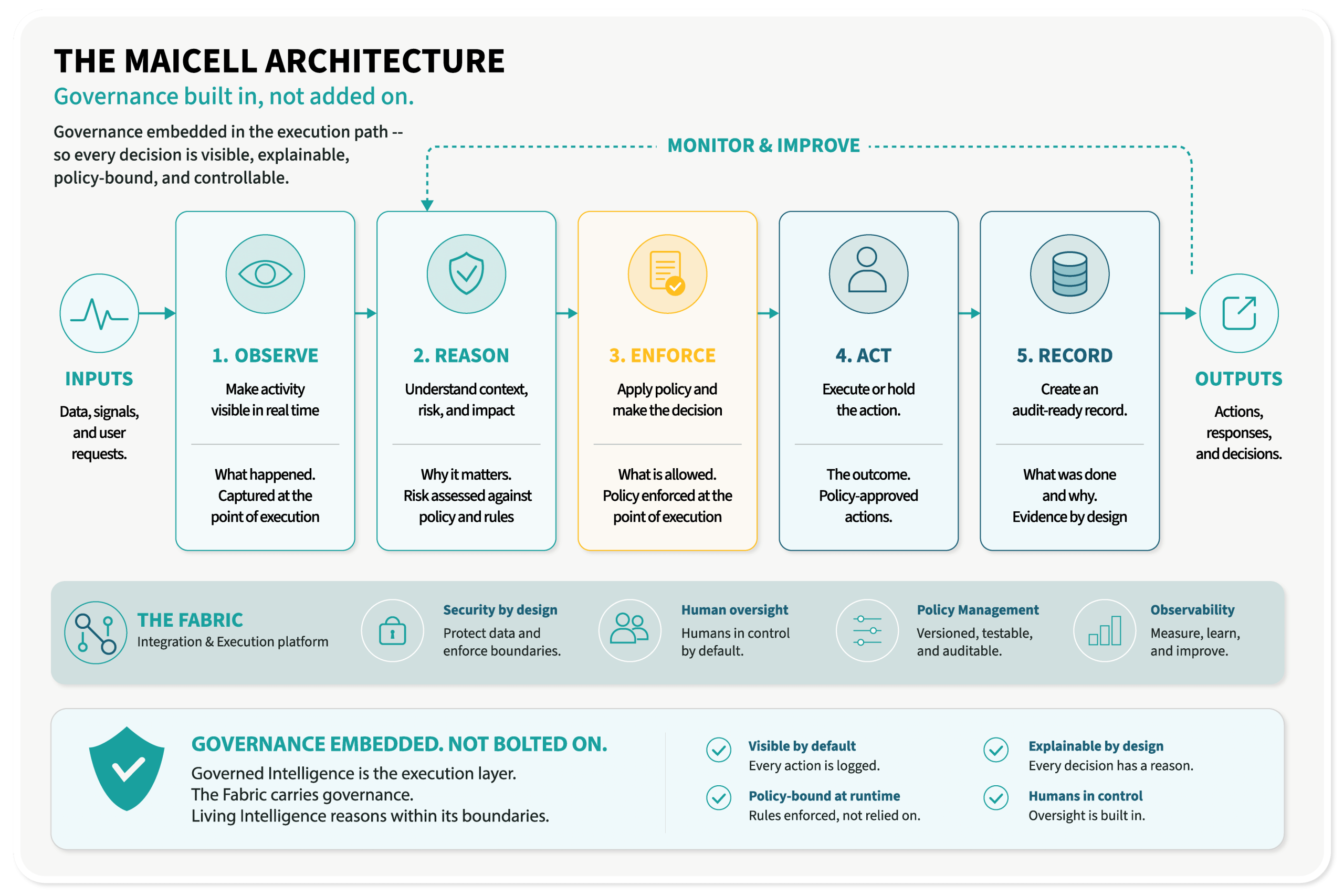
The artchitecture that supports compliance
Governance built in, not added on
Governed Intelligence is the execution layer that makes compliance structural rather than procedural. The EU AI Act describes what governed AI must do. The Fabric is how Maicell delivers it: an integration and execution platform where visibility, explainability, policy enforcement, and human oversight are present by default, not added after deployment.
Living Intelligence reasons over data and generates outputs within the boundaries The Fabric enforces. The Fabric carries the governance: it records each action, surfaces the reasoning behind each decision, enforces policy at the point of execution, and keeps humans in control of what the AI is allowed to do.
Visible, explainable, policy-bound, controlled: these four properties are what the Act requires, and together they define Governed Intelligence. This is the category Maicell has built for. See the full framework on the Governed Intelligence page.
Disclaimer
The information on this page reflects our understanding of the EU AI Act as of June 2026, based on publicly available legislative text and legal commentary. Regulatory obligations vary by system type, sector, and deployment context. We recommend taking independent legal advice on your specific situation.
FAQ – EU AI Act compliance
What is the technical distinction of Living Intelligence?
Living Intelligence applies business logic to real-time operational flows rather than static, historical datasets. This enables the enterprise to respond to fluctuating variables — such as supply chain disruptions — without the delays associated with model retraining cycles.
How does Living Intelligence increase operational velocity?
It automates micro-decisions at the execution layer, such as dynamic inventory routing or order validation. By processing these actions in real-time within governed boundaries, it reduces the latency between data arrival and business outcome.
Is this framework suitable for regulated industries like Finance or Logistics?
Yes. Because it resides within the Governed Intelligence framework, every decision is observable and recorded. This provides the forensic traceability required by European regulatory standards for automated processing.
If the high-risk deadline is December 2027, why act now?
Because the architecture cannot be retrofitted. The properties the Act requires for high-risk systems — visibility, explainability, policy enforcement, human oversight — have to be designed into how a system executes. An enterprise that waits until 2027 faces a rebuild, not a configuration. Article 50 also brings the first obligations forward to August 2026, and meeting those well means building the same architecture the 2027 obligations require.
How does Governed Intelligence support EU AI Act compliance?
Governed Intelligence delivers the four properties the Act’s obligations require, at the execution layer: visible, explainable, policy-bound, and controlled. The Fabric builds these in from the start rather than adding them as documentation after the fact. This is what allows a business to demonstrate compliance for any given decision, rather than describe its compliance in general terms. Compliance also depends on the enterprise’s own deployment, processes, and legal interpretation; Maicell provides the architecture that makes it demonstrable.
Where do we start?
Start with the August 2026 obligations under Article 50, then map your AI deployments against the high-risk obligations that follow in December 2027. Identify which of your systems carry which obligations, and on what timeline. Then speak to the Maicell team about how Governed Intelligence closes the gaps in a single architecture rather than separate builds.