


Most enterprise legal and compliance teams treat the EU AI Act Compliance as a documentation exercise.
Risk assessments to write. Policies to file. Forms to complete. A deadline to manage.
That is how compliance programmes have always worked. You document what you are doing, demonstrate due diligence, and file the paperwork.
But the EU AI Act is not designed that way.
What it actually requires are not documentation categories. They are architectural capabilities. And most enterprise AI systems do not have them.
The deadlines are staged. The architecture decision is not.
The first thing to understand is that the Act applies in stages, and the stages matter.
From 2 August 2026, the transparency obligations under Article 50 are live. Providers and deployers of certain interactive and generative AI systems, or that generate content, have to disclose that AI is in use and mark AI-generated material. This applies broadly, not only to systems classified as high-risk.
The deeper obligations for high-risk systems sit under Annex III: risk management, logging, transparency of reasoning, and human oversight. The Digital Omnibus agreement of May 2026 moved these back to 2 December 2027. They were deferred, not removed. AI embedded in regulated products under Annex I follows from 2 August 2028. One note for the careful reader: on 16 June 2026 the European Parliament gave the Omnibus its final approval. Formal adoption by the Council and publication in the Official Journal are expected before 2 August 2026, at which point the new dates become binding. Until publication, the regulators, the AI Office, and the legal community are already treating these as the working dates.
Here is what most teams miss. The deadlines are staged, but the architecture decision is not. Visibility, explainability, policy enforcement, and human oversight are not features you switch on at a deadline. They are properties a system either has by design or has to be rebuilt to acquire. Build for August, and you are ready for December 2027 without a second rebuild.
What EU AI Act Compliance actually requires
When the Annex III obligations apply, four things have to be true of a high-risk AI system. None of them is a document you write.
Auditability. For every decision the system makes, a structured record exists of what data was used, what logic was applied, and what outcome was produced, at the moment of execution, not reconstructed afterward. A log that says “AI ran at 14:32” is not an audit trail. A structured record of the specific data inputs, the decision boundary applied, and the downstream action triggered is.
Explainability. When a regulator or affected individual asks why a specific decision was made, you can produce an answer that refers to the actual logic of the system, not a general description of how the model works. That is harder than it sounds for systems making thousands of decisions a day.
Human oversight. This is the requirement that causes the most confusion. Most teams read it as having a human who can theoretically intervene. The Act requires something more specific: a meaningful, pre-defined mechanism by which a human can stop, override, or modify the system’s actions. The mechanism has to exist in the architecture before the system deploys. Not as an emergency procedure. As a designed capability.
Ongoing monitoring. Continuous, structured observation of system performance against defined parameters, with the ability to detect drift, flag anomalies, and trigger corrective action. Not a quarterly review. A real-time architectural requirement.
Why this is an integration layer problem
None of these four can be met at the model layer alone.
The model produces outputs. It does not govern what happens to those outputs inside your enterprise, the downstream processes they trigger, the data they touch, the decisions they shape.
That is the integration layer. And that is where governance has to live.
When an AI model flags a customer for a credit review, or routes an order to a different fulfilment centre, or triggers a compliance workflow, the action is not the model’s decision alone. It is the model’s output acting through your integration architecture. The policy that governs that action, the audit trail that records it, and the override capability that can stop it all have to exist in the layer between the model and your enterprise systems.
Most enterprise AI architectures were not built with that layer in mind. The model was connected. The outputs were used. The governance layer was deferred.
Why EU AI Act Compliance is a procurement deadline
This is the framing worth using in every conversation with enterprise procurement teams right now.
EU AI Act compliance is not primarily a legal matter for your compliance team. It is a procurement matter for your enterprise architecture.
Even before the high-risk obligations land in December 2027, the direction of travel is set, and procurement is moving ahead of the legal deadline. Regulated industries, financial services, healthcare, logistics, public sector, are starting to require their AI-using vendors and partners to demonstrate governed architecture. The question “can you show us your audit trail?” is moving from a due diligence nicety to a procurement gate.
The organisations that have already built the governance layer will move through that gate faster. The ones that have not will be rebuilding their architecture under commercial pressure, against a 2027 clock that is shorter than it looks.
What a governed integration layer looks like
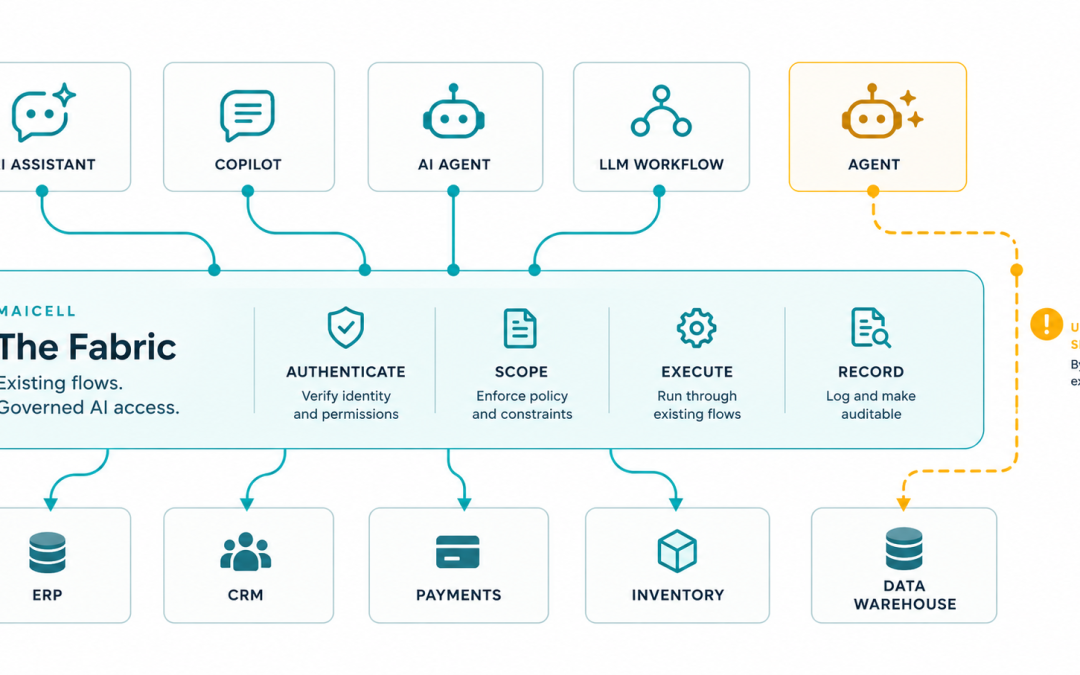
At Maicell, we call this The Fabric, the governed control plane that sits between AI models and enterprise systems.
The Fabric provides each capability as an architectural feature, not a compliance add-on.
Policy enforcement happens before AI actions execute, not in a post-hoc log, but at the execution layer.
Audit trails are structured at the point of action, every decision, every data source, every downstream trigger recorded in a form that can be produced to a regulator on request.
Human oversight is designed in, override capability that exists as a real architectural mechanism, not a theoretical possibility.
Monitoring is continuous, real-time observation of system behaviour against defined parameters, with structured alerting and correction.
This is what Governed Intelligence means in practice. Not AI with compliance bolted on. AI that operates inside a governed architectural layer from the start.
The question to ask now
If you are deploying AI systems in your enterprise environment, here is the question worth asking before the deadlines arrive:
Do we have a governed control plane, the layer where AI policy is defined, enforced, audited, and overridden?
If the answer is no, the path is not to write more compliance documentation.
The path is to build the architectural layer that makes EU AI Act compliance possible.
Article 50 is live from August 2026. The high-risk obligations follow in December 2027. The window to build it properly, designed in, not retrofitted, is now.




0 Comments