

Governed Intelligence
Govern AI decisions as they happen, not after.
Maicell® helps organisations govern AI and automation decisions at the moment of execution, applying policy, auditability, and control before actions become operational outcomes.
Enterprise AI Risk
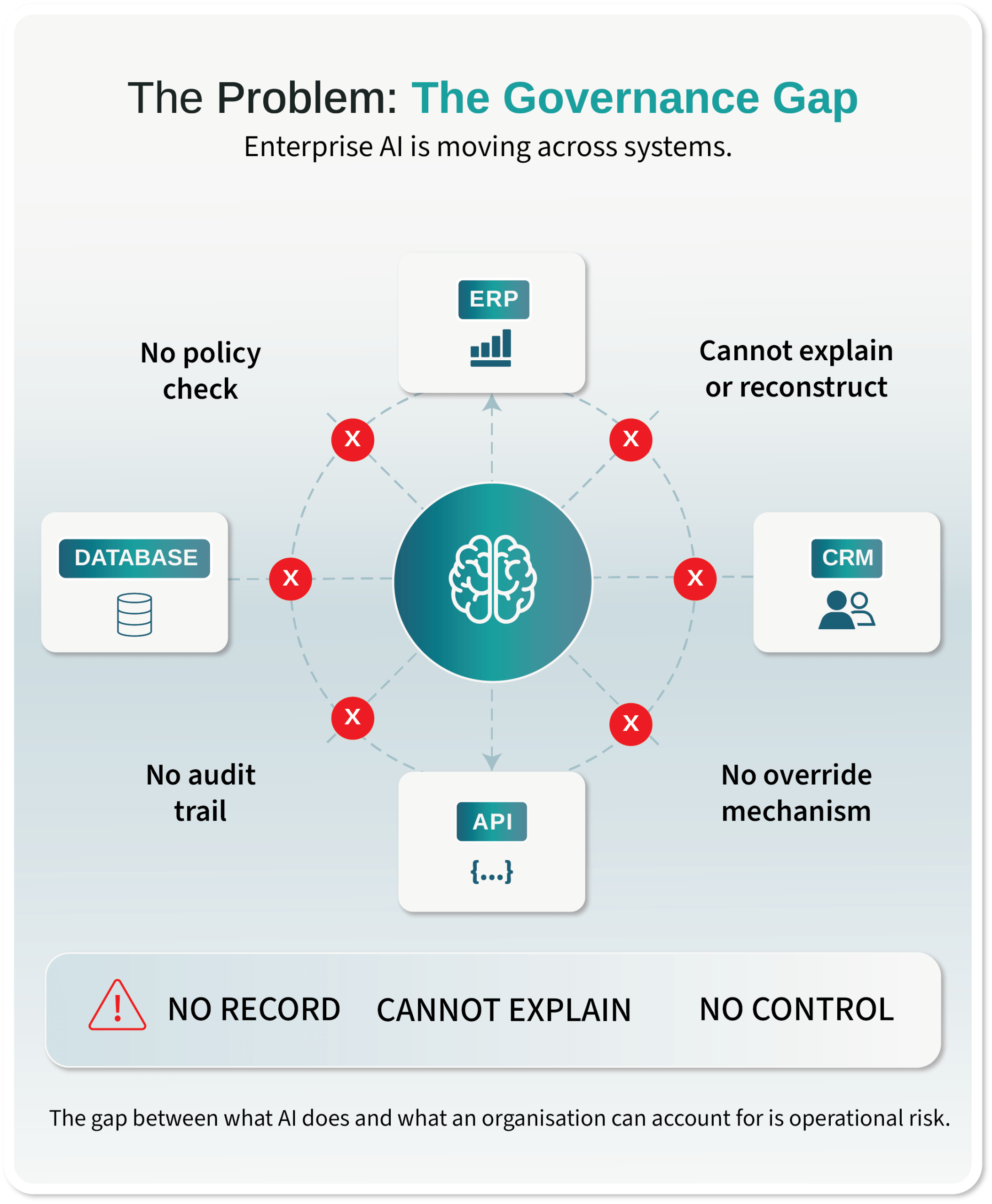
AI is making decisions faster than organisations can account for.
AI is making decisions faster than organisations can account for. Most of those decisions happen without a clear record of what was decided, on what basis, or against which rules. The pace of automation has outrun the institution’s ability to keep track of it.
Governed Intelligence closes that gap. It moves policy from the document layer into the execution layer, so what an organisation expects of its AI is built into the way the AI runs, not reconstructed afterwards.
For many enterprises, that governance also depends on where data is accessed and how it moves. Maicell’s local agent approach allows intelligence and automation to work with enterprise data in controlled environments, including on-premise systems, without exposing more of the operational landscape than necessary.
Governed Intelligence Defined
A working definition
Governed Intelligence has four properties. A system that lacks any one of them is not governed. It is monitored, which is different.

Visible
Governed decisions are recorded with their inputs, the policy applied, and the outcome. No silent acts. No missing entries.
Explainable
The reasoning behind a decision can be reconstructed in business language. Not in model weights. Not in stack traces. In the language the institution actually uses.

Policy-Bound
Constraints are enforced at the moment of execution. Non-compliant actions can be blocked, routed, or escalated before they become operational outcomes. They are not merely flagged after the fact.
Controlled
Decisions are governed through a clear control trail. Where correction is required, the record of what happened, why it happened, and which policy applied remains intact.
Policy Enforcement
Policy in the execution layer
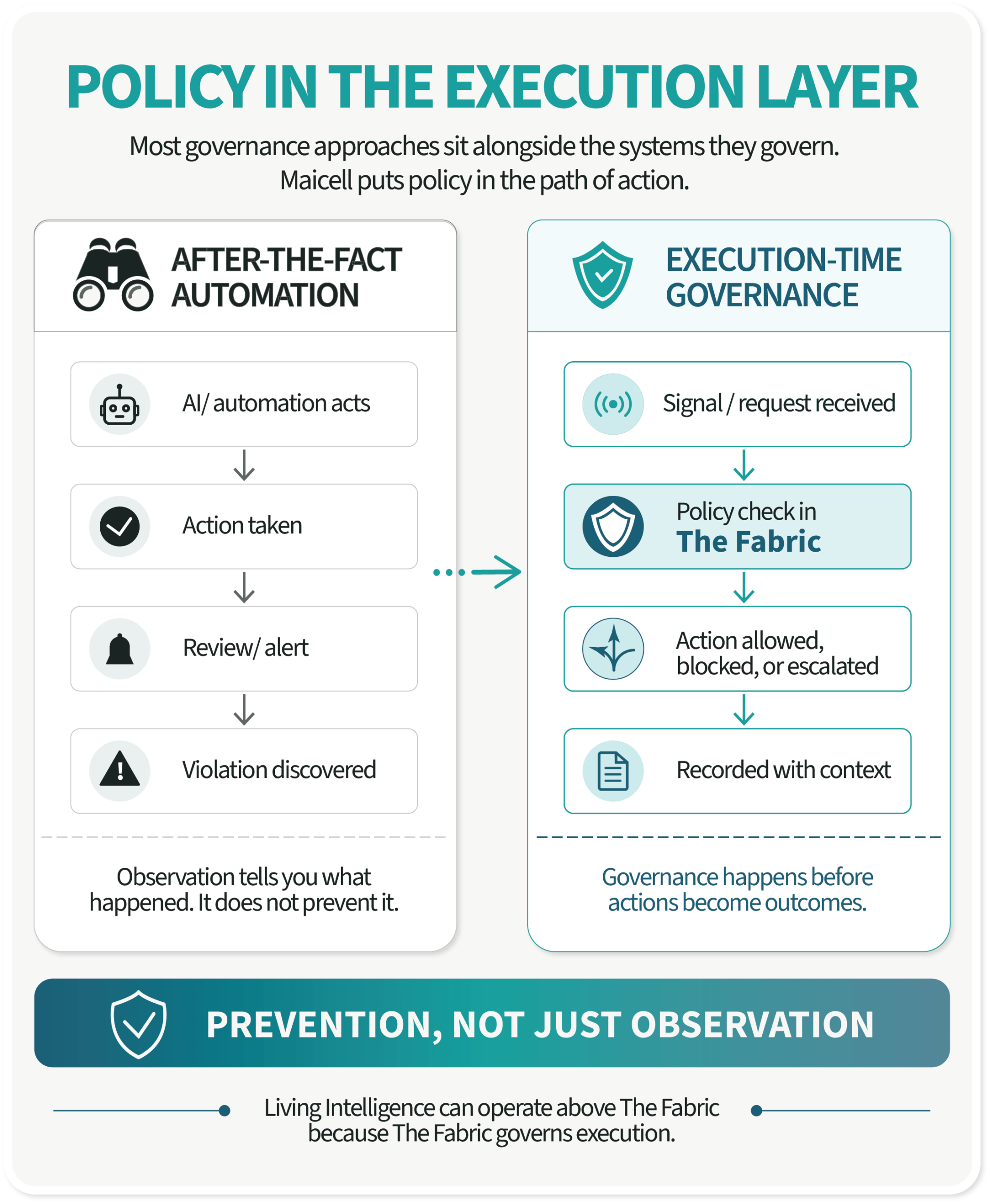
Most governance approaches sit alongside the systems they govern. They observe, log, and alert. Maicell takes a different position.
The Fabric is Maicell’s product architecture for Governed Intelligence: the governed control plane and execution layer that makes policy enforceable at the moment decisions become actions. It embeds policy, control, and audit into the path that intelligence, automation, and data follow across enterprise systems.
Compliance is not a downstream check. It is a precondition for the action.
Through Maicell’s local agent approach, this governed execution model can operate close to the systems and data it acts on, including on-premise environments.
That is what allows Living Intelligence to operate above The Fabric without becoming uncontrolled. As enterprise operations become more responsive and policy-aware, The Fabric keeps decisions inside the boundaries the organisation has set.
The same governed execution model can operate in Maicell-native deployments and alongside existing iPaaS estates where governance, observability, policy enforcement, and control are missing.
Through local agents and controlled runtime options, The Fabric can operate close to the systems and data it governs, including on-premise environments.
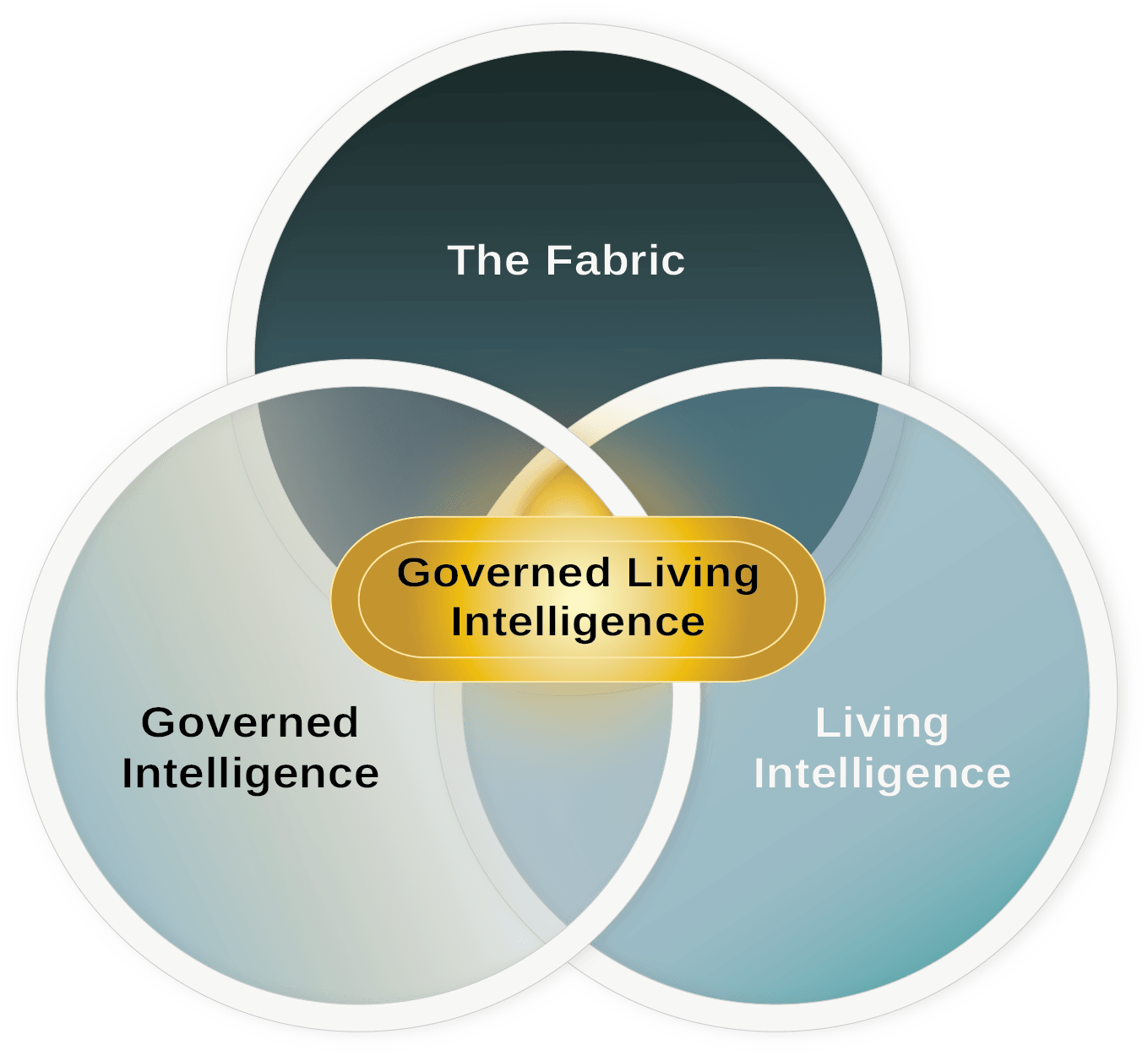
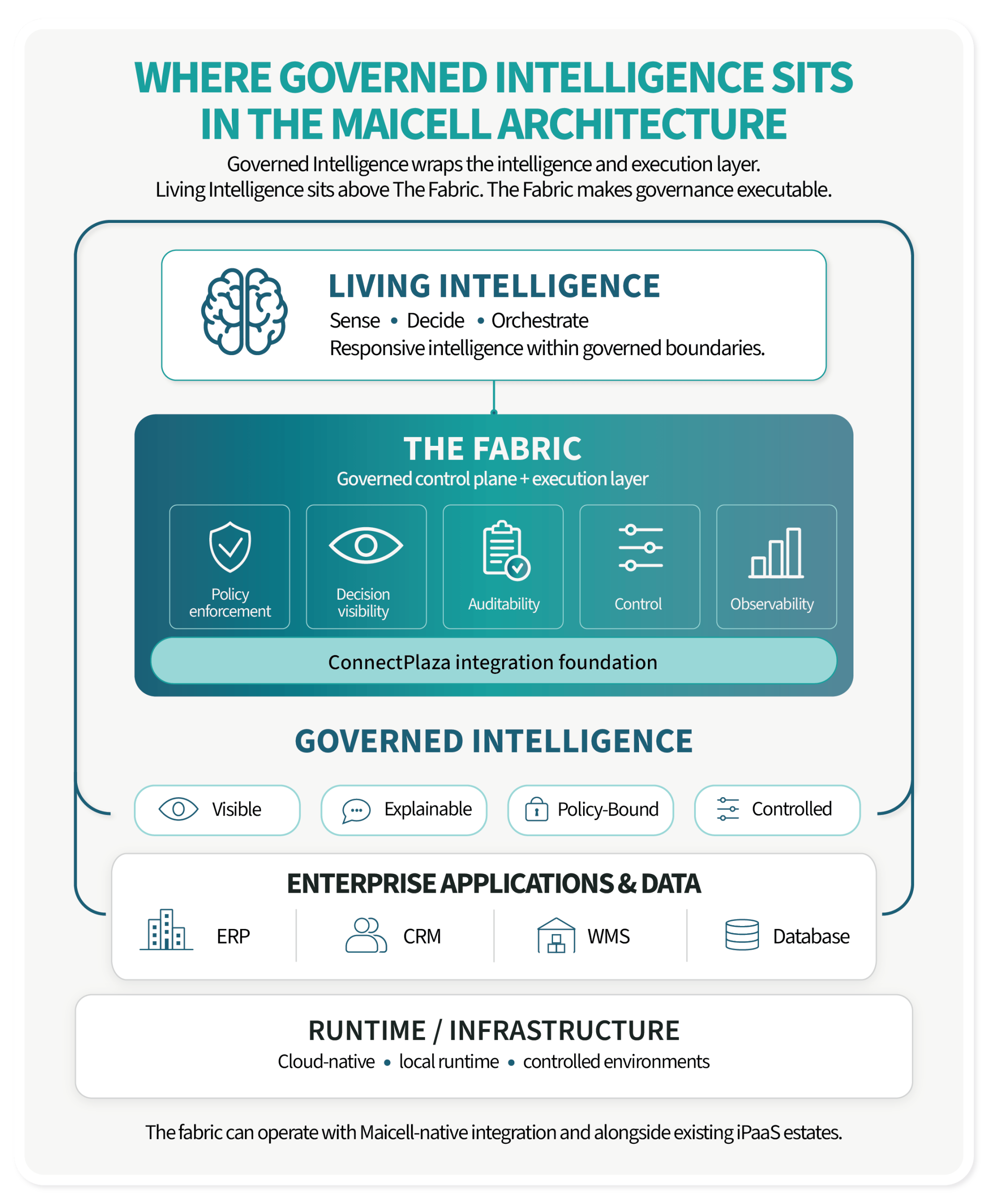
In the full model, Governed Intelligence wraps the intelligence and execution layer. Living Intelligence sits above The Fabric. The Fabric makes governance executable.
Enterprise Outcomes
The operational difference
For the CIO
A reliable audit trail across integration, automation, and intelligence. Not three separate forensic exercises when something goes wrong.

For the Compliance Lead
Regulatory requirements expressed as enforceable policy, applied in production, with evidence the regulator can inspect without a six-week reconstruction project.
For the Operational Lead
Faster automation cycles without an expanding queue of post-hoc reviews. Approvals that would otherwise require manual review can be routed and resolved inside the workflow.

For the Board
A defensible answer to the question now appearing on every risk register: can we explain what our AI is doing?
Underneath these properties is Maicell’s secure execution architecture. Local agents and controlled runtime options allow governed decisions to operate close to enterprise data, including on-premise environments, without turning governance into another external black box.
Maicell architecture
The wrapper around the model, not a layer inside it.
Governed Intelligence is the category Maicell claims, the principle that governs the architecture, and the product capability delivered through The Fabric. It defines how enterprise AI and automation decisions should behave: visible, explainable, policy-bound, and controlled before they become operational outcomes.
Living Intelligence sits above The Fabric. It is the intelligence layer that senses, decides, and orchestrates across enterprise operations while remaining inside the boundaries the organisation has set.
The Fabric is the product architecture that makes this executable. It acts as the governed control plane and execution layer, embedding policy, visibility, auditability, and control into the path decisions and actions follow.
ConnectPlaza provides the integration foundation within The Fabric. Where enterprises already have integration platforms in place, The Fabric can also operate alongside existing iPaaS estates to add governance, observability, policy enforcement, and execution control.
In the full model, Governed Intelligence wraps the architecture. Living Intelligence sits above The Fabric. The Fabric makes governance executable.
Category Definition
What Governed Intelligence actually does
FAQ – Governed Intelligence
Does Governed Intelligence replace our existing integration platform?
No. Governed Intelligence is the layer that governs what AI is allowed to do across the systems your integration platform connects. Most enterprises have years of investment in their existing iPaaS, and that investment does not need to be unwound. The Fabric, Maicell’s architectural layer, can be introduced into existing environments where governance is missing, or deployed as part of a complete integration and governance platform together.
Does Governed Intelligence remove the need for human review?
Governed Intelligence moves that review forward: humans define the rules in advance, in business language, and the system enforces those rules at the moment of execution. Decisions inside the rules flow through. Decisions that fall outside them are escalated for human attention, with the full context attached. Oversight remains, but it scales.
How is this different from AI observability, model risk management, or data governance?
Observability tells you what a model did after it acted. Model risk management evaluates models in isolation, before they reach production. Data governance addresses the inputs systems consume.
Governed Intelligence is the layer that governs the actions taken, in production, at the moment they happen. The four disciplines are complementary, not competitive. Most enterprises need all of them. The comparison table above sets out the boundaries in more detail.
Can governed decisions be reversed if something goes wrong?
Yes, under controlled conditions, with the audit trail intact. The technical mechanism depends on the action. Some are unwound by rollback, others by compensating actions. But the principle is the same: a governed decision is one that can be undone without losing the record of what happened or why.
How does Governed Intelligence support compliance with regulations like the EU AI Act?
Governed Intelligence helps turn compliance requirements into operational controls. Regulations such as the EU AI Act place increasing emphasis on visibility, explainability, human oversight, and evidence around AI-driven decisions.
The Fabric helps translate those requirements into executable rules that govern behaviour at the moment of action and produce audit evidence for review. Maicell’s team can discuss specific regulatory contexts in detail.
From the threads
The argument behind the category
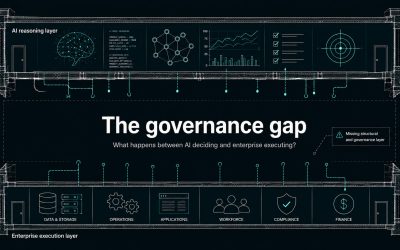
The Governance Gap: what nobody in enterprise AI is talking about
Enterprise AI is making decisions faster than organisations can account for them. Joost de Bot, CEO of Maicell, on the governance gap — why it exists, why it is growing, and why Governed Intelligence is the architectural answer.