

THE BASICS
What is iPaaS?
iPaaS, or Integration Platform as a Service, is a cloud-based platform that connects applications, data and systems across an enterprise without requiring heavy custom code. It is the modern form of what the industry has long called enterprise application integration, delivered as a cloud service.
Instead of building individual connections between every tool you use, an iPaaS platform provides a central layer that manages all of those connections in one place. You can think of it as the backbone that allows your business systems to share information reliably, in real time, and under a consistent set of rules.
The reason this matters now is scale. Zylo’s 2026 SaaS Management Index reports an average portfolio of 305 SaaS applications. In enterprise environments, those cloud applications often coexist with on-premise systems. Without a central integration layer, each new system creates a new problem: siloed data, duplicated processes, and no single view of what is actually happening across the business. A governed enterprise integration platform solves this by acting as a shared foundation that every system connects to, rather than a tangle of one-to-one connections.
There is also a deeper reason why governed integration has become essential, and it goes beyond operational efficiency. AI systems are being deployed inside enterprise environments right now, making decisions and triggering actions across connected platforms. Without a connected, observable integration layer, those AI decisions lack the context and the control that enterprises need to operate responsibly. Governed integration has stopped being a purely technical concern. It is the foundation for AI readiness.
Under the hood
How does iPaaS work?
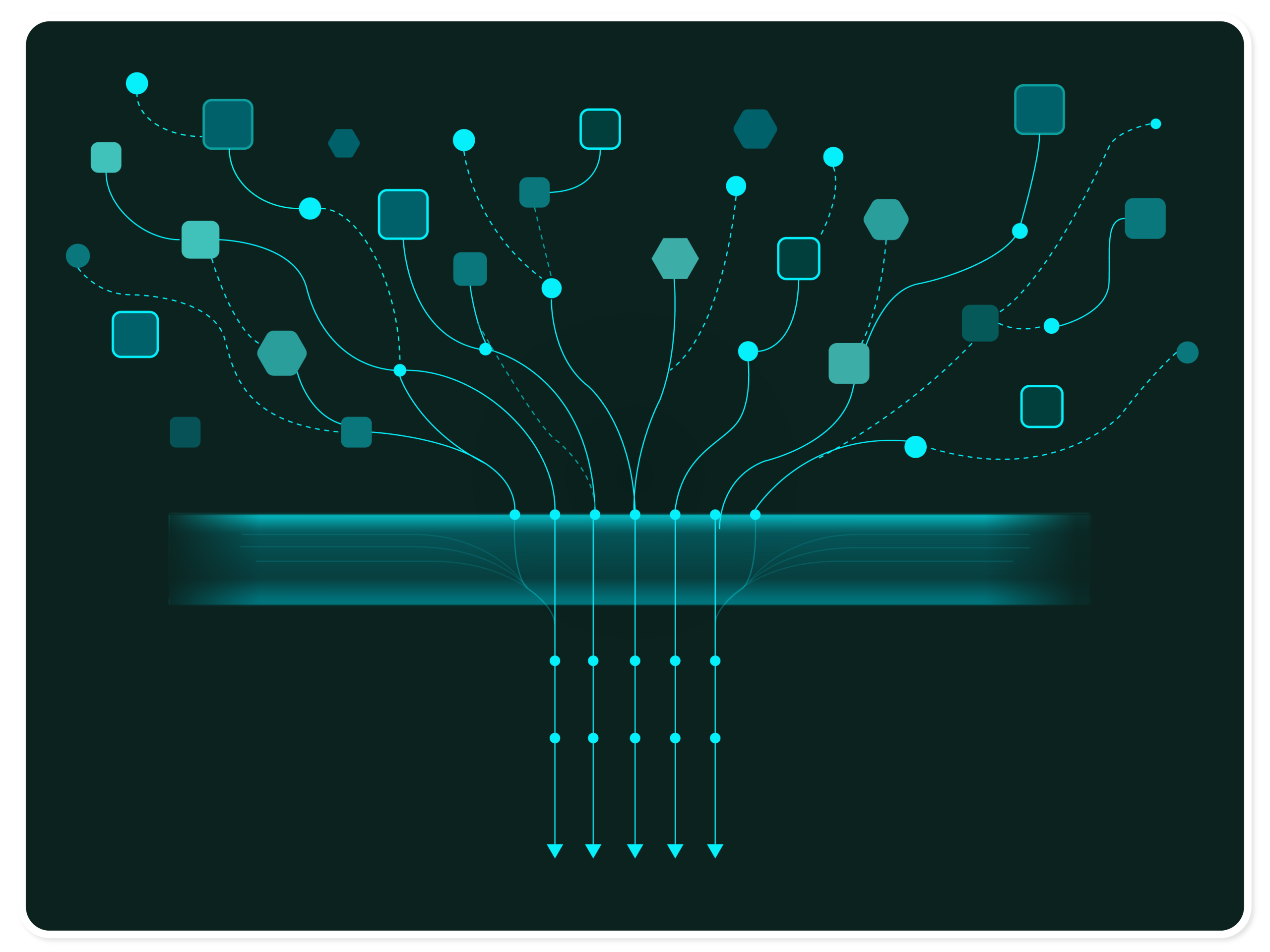
An iPaaS platform sits between your enterprise systems and manages the flow of data between them. It can handle data exchange in real time or on a scheduled basis, and it works across cloud applications, on-premise infrastructure and hybrid environments simultaneously. Rather than each system needing a custom-built connection to every other system, they all connect to a single integration layer that handles the routing, transformation and delivery of data.
For many organisations, this replaces an older approach known as point-to-point integration, where each pair of systems had its own direct connection. That approach works when you have five or six systems. It becomes unmanageable at enterprise scale. Legacy middleware platforms tried to address this, but they were often slow to update, expensive to maintain, and not built for the pace of modern cloud environments.
The most important change in the shift to a modern integration platform as a service is that governance now belongs inside the integration layer itself, rather than being added afterwards. What that means in practice, and why it matters for AI, is covered later in this article.
Connecting cloud and on-premise systems
One of the most practical things an iPaaS platform does is bridge the gap between modern SaaS applications and existing legacy infrastructure. Most enterprises cannot simply replace their on-premise ERP or core operational systems overnight. They need both worlds to work together, and they need that connection to be reliable, secure and fast. This is the practical route to legacy modernisation: connecting what you have to what you are adopting, one flow at a time, instead of attempting a risky wholesale replacement.
This becomes especially important as AI agents begin operating across enterprise environments. An AI agent that is triggering actions in your ERP, reading customer data from your CRM, and updating records in your logistics platform needs real-time data availability to make sensible decisions. A hybrid integration platform that connects all of these systems in real time gives AI agents the accurate, up-to-date context they need to act correctly.
Centralising API management
A governed iPaaS also takes responsibility for managing the full lifecycle of your APIs, from creation through to retirement. This includes controlling who can access which APIs, enforcing usage policies, monitoring traffic, and ensuring that outdated or insecure API versions are retired properly.
This is becoming increasingly important as AI agents interact with enterprise systems through APIs. An ungoverned API landscape is a serious risk when automated systems can call those APIs at scale. A central API management layer within your enterprise integration platform ensures that every interaction, whether triggered by a human or an AI agent, follows the same access control rules and policy constraints.
Orchestrating workflows and automations
Beyond connecting systems and managing APIs, iPaaS platforms enable organisations to build and run automated workflows across departments. Most modern platforms offer low-code or no-code tools that allow business teams to design processes without relying entirely on developers. This reduces manual effort, speeds up execution, and makes processes more reliable.
The connection to AI agent management here is direct. Agentic AI workflows, where AI systems take sequences of actions across multiple systems, require a governance layer that makes every step observable, keeps a human in the loop for the decisions that need one, and allows actions to be stopped where needed. Without orchestration built into the integration layer, it is impossible to know what an AI agent did, why it did it, or how to intervene when something goes wrong. Governed Intelligence means that every action is policy-aligned before it executes, not reviewed after the fact.
WHY IT MATTERS
What are the key benefits of iPaaS for enterprises?
Enterprises that move to a governed integration platform see benefits across several dimensions. The most immediate is a reduction in integration complexity. Instead of managing hundreds of fragile point-to-point connections, IT teams work from a single, consistent platform that gives them visibility and control across the entire technology estate.
Real-time data visibility is another significant gain. When all systems feed into a central integration layer, business teams get access to accurate, current information rather than working from yesterday’s exports or manual reports. This also underpins AI decision-making. AI systems can only make good decisions when they have access to trustworthy, real-time data.
Governance and access control become far easier to manage from a single control plane. Compliance requirements, audit trails and policy enforcement can be applied consistently across every integration rather than configured separately for each connection. This is particularly relevant for organisations navigating regulations such as the EU AI Act, which, for high-risk AI systems, requires record-keeping, transparency and human oversight.
Flexible deployment matters too. A well-designed enterprise integration platform works across cloud, on-premise and hybrid environments without forcing organisations to choose one or migrate everything at once. And as AI agent operations scale, a governed iPaaS helps keep the actions those agents take policy-aligned, observable and overridable, giving enterprises the confidence to grow their AI capabilities without losing control.
IN PRACTICE
iPaaS use cases across industries
Governed enterprise integration delivers different but equally important value depending on the industry. The common thread is the need for reliable, real-time data flows combined with governance that supports both operational efficiency and regulatory compliance.
Retail
In retail, governed integration connects inventory systems, order management platforms and customer data in real time. When a customer places an order, the system needs to confirm stock availability, trigger fulfilment, update customer records, and potentially adjust pricing or recommendations, all without delay. A fragmented integration approach makes this unreliable and slow.
Beyond operational efficiency, connected retail systems are increasingly the engine behind AI-driven personalisation. Recommending the right product at the right moment requires real-time access to purchase history, browsing behaviour and inventory data simultaneously. That is only possible on a governed, real-time integration foundation.
Logistics
Logistics operations depend more than almost any other industry on accurate, real-time data flows. Shipment status, route planning, warehouse capacity, carrier availability, customs data: all of this information needs to move between partners, systems and teams instantly and reliably. Much of it still moves over EDI and B2B messaging, the workhorse formats of supply chain data exchange, and those flows need the same governance as modern APIs. A single missed update can cascade into costly delays.
As logistics companies begin deploying AI to support autonomous decision-making, such as dynamic routing or predictive maintenance, the need for governed AI execution becomes critical. An integrated logistics platform with governance built in ensures that AI-driven decisions are based on accurate data, operate within defined boundaries, and can be overridden by human operators when needed.
Financial services
Financial services organisations face some of the most demanding compliance requirements of any industry. In many regulated financial-services use cases, requirements around auditability, transparency and human oversight are mandatory. A governed integration layer provides the infrastructure to meet these requirements consistently across every system and workflow.
The EU AI Act adds particular obligations for organisations using AI in high-risk contexts. In financial services, that includes use cases such as assessing the creditworthiness of individuals and risk assessment and pricing in life and health insurance. For those use cases, auditability, explainability and the ability for people to oversee and intervene in AI actions need to be structural properties of the architecture, not something retrofitted when an audit arrives.
how it compares
How does iPaaS compare to other integration approaches?
There are several ways enterprises can approach integration, and each has genuine strengths alongside real limitations. The table below gives a quick overview before we go into more detail.
| Approach | Best used for | Key benefit | Key limitation |
|---|---|---|---|
| Direct API integration | Connecting two specific systems | Simple, fast to set up | Breaks down at scale; hard to govern |
| Enterprise Service Bus (ESB) | Legacy enterprise environments | Mature, well understood | Slow, expensive, not cloud-native |
| Custom-built solutions | Highly specific requirements | Full control | High cost, hard to maintain |
| ETL / data warehousing | Batch data processing and analytics | Strong for reporting | Not suited to real-time operational flows |
| Middleware | Bridging older systems | Proven in stable environments | Limited flexibility for modern SaaS stacks |
| Workflow automation tools | Departmental process automation | Easy to use | Limited governance and enterprise scalability |
| Governed iPaaS | Enterprise-wide integration with AI governance | Scalable, governed, AI-ready | Requires thoughtful implementation |
| Stage | What it covers | What it delivers |
|---|---|---|
| Connect | Direct API · Point-to-point · File transfer | Simple connections |
| Integrate | ESB · Middleware · Data integration | Shared data |
| Orchestrate | Workflow automation · iPaaS · Hybrid integration | Connected processes |
| Govern | Governed iPaaS · Policy enforcement · AI-ready | Trusted execution |
Direct API integrations work well when you are connecting two systems and the connection is unlikely to change. The problem is that this approach does not scale. Each connection is managed separately, governance is inconsistent, and when one system changes its API, it can break everything downstream.
An Enterprise Service Bus, or ESB, was the previous generation’s answer to integration at scale. ESBs are mature and well understood, but they were designed for on-premise environments and do not adapt well to the pace of modern cloud-native architectures. Many enterprises still have ESBs running and are actively looking to migrate.
Custom-built integration solutions offer full control but come at significant cost. They take time to build, require specialist developers to maintain, and tend to become technical debt as the systems around them change. ETL tools and data warehousing platforms are excellent for moving and transforming data in bulk for analytics, but they are not designed for the real-time operational flows that AI agents and modern enterprise processes require. Workflow automation tools are useful for departmental processes, but most lack the governance, API management and enterprise-scale reliability needed to act as a central integration layer.
Governed iPaaS brings together scalability, compliance and AI readiness in a single platform. It is the only approach on this list that treats governance as a core architectural concern rather than something bolted on after the fact.
the governed difference
What makes a governed integration platform different?
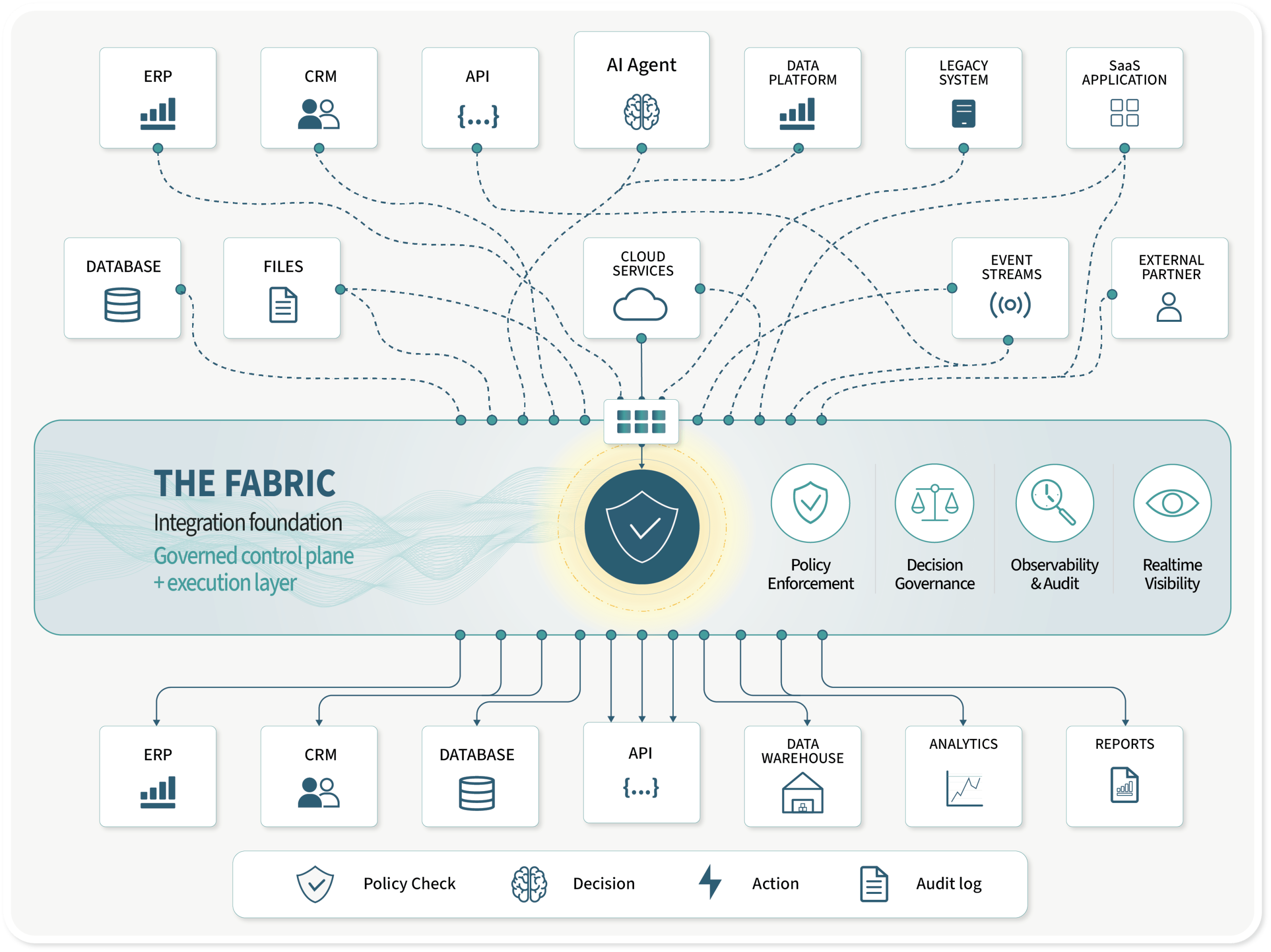
A standard iPaaS connects systems and automates data flows. A governed integration platform does all of that, and then goes further by embedding policy enforcement, observability and human oversight into the execution layer itself. In practice it is both an integration platform and an AI governance platform in a single architecture.
The distinction matters enormously as AI becomes part of enterprise operations. Most integration platforms can tell you what data moved between systems. A governed control plane is designed to show which AI actions took place, check them against policy before they execute, and let people step in when needed.
This is what Maicell calls Governed Intelligence: the operating principle that every AI action in your enterprise is observable, policy-aligned and overridable, before it executes, not after. Governance is not a compliance report you read on Monday morning. It is the layer that decides what your AI is allowed to do in the first place.
The Fabric is the architectural expression of this principle. Rather than treating governance as a separate module or an add-on compliance tool, The Fabric embeds it directly into the integration layer. Every connection, every API call, every automated workflow and every AI agent action runs through the same governed execution environment.
The foundation is proven. More than 1,500 organisations across retail, logistics, utilities and other regulated industries run their integration on ConnectPlaza, the governed integration platform at the core of Maicell, where governance has been part of the architecture from the start. Maicell extends that proven foundation from governed integration into governed AI execution, extending the same governance approach to AI-triggered actions routed through Maicell.
Governance is only as strong as the systems it reaches. Many enterprises run a mix of cloud applications, on-premise systems and legacy platforms that cannot simply be switched off, and many still rely on EDI and B2B messaging for partner traffic. Maicell’s foundation was built for exactly that reality: hybrid and on-premise deployment, legacy modernisation one flow at a time, and EDI and B2B exchange alongside modern APIs. Governance that covers all of those flows, not just cloud-to-cloud connections, is what makes it hold up in practice.
is it for you?
Is iPaaS right for your organisation?
One of the most common questions enterprises ask is whether iPaaS is only for large organisations with dedicated IT departments. The honest answer is no. Modern governed integration platforms are designed to work across a range of organisation sizes and technical maturity levels. The largest enterprises benefit from the full depth of API management, AI governance and compliance tooling, while mid-sized organisations can start with a narrower scope and expand as their needs grow.
Implementation time varies with the complexity of your existing technology estate, but modern platforms are designed to reduce the time and effort involved compared to legacy middleware or custom builds. Many organisations see meaningful value within the first few months of deployment. As for whether you need a team of developers, the answer depends on what you are building. Low-code and no-code tools allow business teams to build and manage many integrations and workflows themselves. More complex enterprise integrations and governance configurations will involve technical teams, but the barrier is lower than it has ever been.
what comes next
What comes after iPaaS
The integration industry has spent three decades solving one problem: connectivity. That problem is now largely solved, and connection is becoming cheap. Almost any system can reach almost any other, and with AI in the stack, the number of connections is about to multiply. The question that defines the next era is different. It is not what your systems can connect to. It is what your connected systems, and the AI acting through them, are permitted to do. Who approved it, who can stop it, and where is the record?
That question is why the conversation is moving from integration to Governed Intelligence: the principle that intelligence operating across your enterprise remains observable, policy-aligned and overridable at the moment it acts. It changes what buyers should look for in a platform today, because a platform chosen this year has to carry you into that era.
Maicell co-founder Paul Lange makes the full argument in his essay What comes after iPaaS. For the working definition of the category, see Governed Intelligence. And if you are evaluating platforms against the EU AI Act, start with the criteria that matter.
FAQ
Frequently asked questions
What is iPaaS and how does it differ from traditional middleware?
Why does enterprise AI need a governed integration layer?
AI systems operating inside enterprise environments make decisions and trigger actions across connected systems. Without a governed integration layer, there is no reliable way to know what those actions were, whether they were policy-aligned, or how to override them. A governed control plane is designed to make AI actions observable and overridable before they execute, not reviewed after something has gone wrong.
What is the difference between iPaaS and a governed control plane?
How does iPaaS support EU AI Act readiness?
For high-risk AI systems, the EU AI Act requires, among other things, record-keeping, transparency and human oversight. A governed integration platform supports this by recording an audit trail of AI-triggered actions, enforcing the policies that determine what AI systems are allowed to do, and enabling human oversight and intervention. Maicell builds these capabilities into The Fabric by design, so readiness is structural rather than a manual reporting exercise.